The Gray Treefrog: A Midwesterner's Guide to Finding (and Hearing) Them
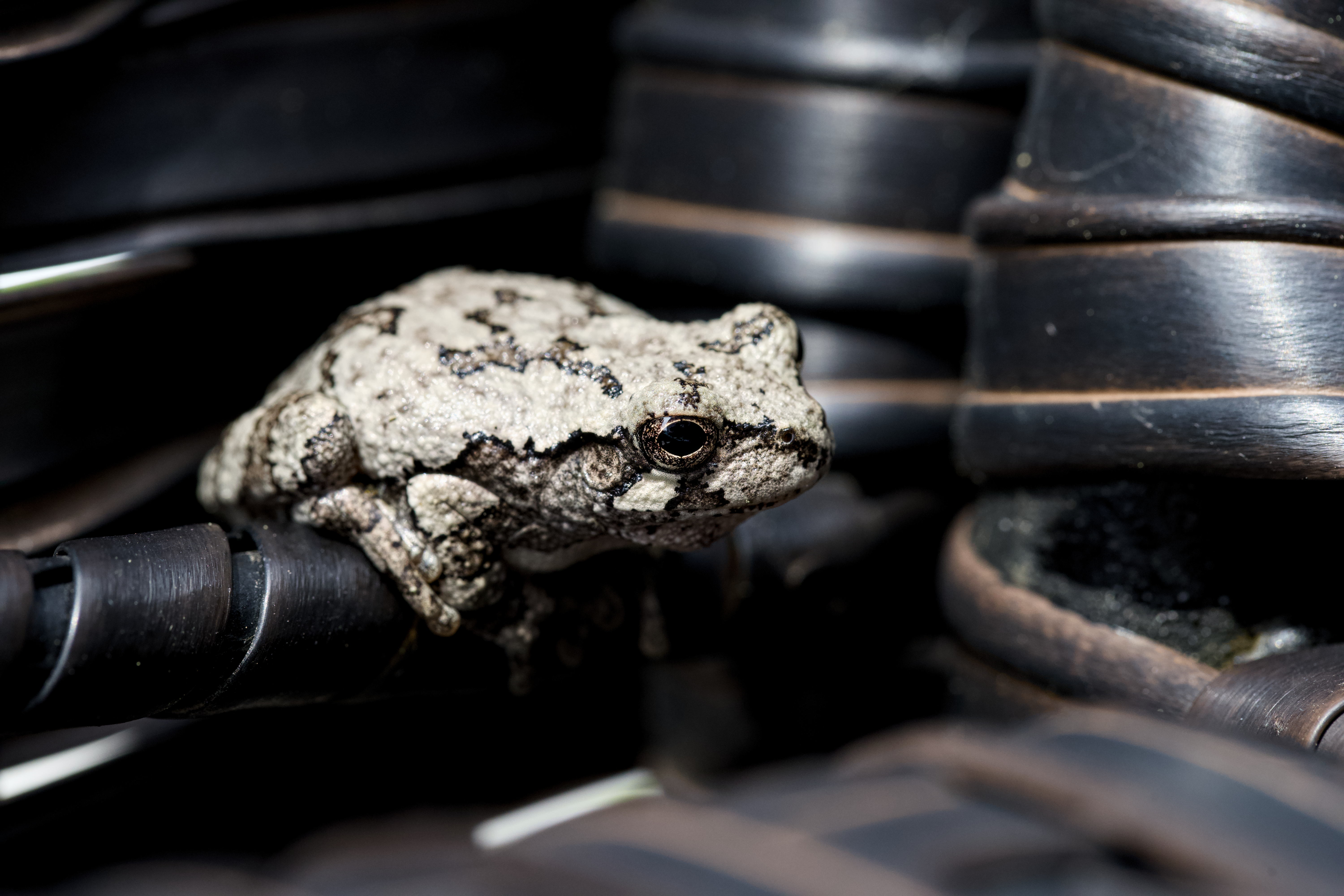
Most people who have a gray treefrog living in their backyard have never seen it. They’ve heard it — the loud, resonant trill coming from the oak tree at dusk on a warm May evening — but they assumed it was an insect or a bird. It wasn’t. It was a frog the size of a large grape, perched somewhere high in the canopy, doing what gray treefrogs do every spring: announcing itself with extraordinary volume from an extraordinarily small body.
Finding one for the first time is a minor revelation.
Two species, one problem
When you look up “gray treefrog,” you immediately run into a herpetologist’s headache: there are actually two species in the Midwest that are functionally identical to the naked eye. Hyla versicolor (Eastern Gray Treefrog) and Hyla chrysoscelis (Cope’s Gray Treefrog) look so alike that even experts can’t reliably separate them by appearance. Both are small — 1.5 to 2 inches — with rough, warty skin that shifts between gray, green, and brown depending on temperature and substrate. Both have bright orange-yellow flashes on the inner thighs, visible only when they jump. Both stick to trees.
The difference is in the call. H. versicolor produces a slow, musical trill; H. chrysoscelis is faster and buzzier. DNA and chromosome counts are the only way to be certain. For most purposes — field ID, photography, location scouting — you don’t need to know which one you’re looking at. They occupy overlapping ranges, use the same habitat, and respond to the same search strategies.
Throughout this post, “gray treefrog” means either species. If you’re in the western Midwest (Nebraska, Kansas, Iowa west of the Missouri), you’re more likely dealing with Cope’s. East of there, both occur.
Where they live across the Midwest
Gray treefrogs are more widespread than most people realize. Their range covers essentially all of the eastern half of North America, and in the Midwest specifically, they’re present in:
Iowa — Statewide in wooded habitat, though sparser in the heavily agricultural northwest quarter. Particularly dense along the Missouri River corridor, the Mississippi bluffs, and anywhere river bottomland forest meets upland. Neal Smith National Wildlife Refuge and the Des Moines River corridor are reliable.
Illinois — Statewide. Shawnee National Forest in the south holds high densities. Common in forest preserves throughout the Chicago metro.
Missouri — Statewide and abundant. The Ozarks are prime territory, but they’re just as present in riparian corridors through the agricultural north.
Minnesota — Present through much of the southern two-thirds of the state. The southeastern bluff country along the Mississippi holds strong populations. Rarer in the northern boreal forest.
Wisconsin — Statewide south of the tension zone, present but patchier north of it. Common in the Driftless Area and throughout the glaciated southern counties.
Indiana and Ohio — Statewide in both states, often common in suburban and urban parks with mature tree cover.
Michigan — Throughout the Lower Peninsula and into the Upper Peninsula in the south.
Nebraska and Kansas — Eastern portions only, following the wooded river corridors west into the Great Plains. The Missouri River valley in eastern Nebraska is the reliable western edge.
The pattern in all of these states is the same: wooded habitat near standing water. They breed in ponds, sloughs, flooded fields, and slow backwaters, but spend most of the year in trees, often well away from water. A wooded suburban neighborhood with a neighbor’s swimming pool or a retention pond nearby can support a population just as well as a wildlife refuge.
When to look
The calendar matters. Gray treefrogs hibernate from roughly October through March, buried under leaf litter or in rotten logs, occasionally in loose soil. As temperatures climb in April, they emerge, but the real action starts when nights stay consistently above 55°F — typically mid-May in Iowa and the central Midwest, a bit earlier in Missouri, a bit later in Minnesota.
May through July is breeding season. This is when they’re most vocal and most findable. Males call from vegetation at the pond’s edge and from trees overlooking the water, sometimes from 30 feet up. The calls start at dusk and continue through the night. A warm, humid, calm evening after a rain is the best possible night to be out.
By August, calling drops off dramatically. Adults disperse back into the canopy and juveniles — tiny green versions of the adults, the size of a thumbnail — begin appearing on plant stems and window screens. You can still find them in August and September, but you have to look rather than listen.
How to find one
The most reliable method is embarrassingly simple: go outside after dark on a warm May or June night when you can hear them calling, walk slowly toward the sound, and sweep the vegetation at eye level with a headlamp. Gray treefrogs produce their trill by inflating a vocal sac under their chin — the sac glows translucent when lit from behind. Walk toward the call, stop, listen, locate the sac.
The hard part is that calls carry farther than the frog. What sounds like it’s coming from ten feet away is often thirty feet away and twenty feet up. Be patient. Work the perimeter of the pond. Look at every branch at chest height. Eventually you’ll find one sitting motionless — they hold extremely still when a light hits them, which is both what makes them findable and what makes them such cooperative photographic subjects.
A few other reliable spots:
Window wells and foundation plantings. On breeding nights, gray treefrogs turn up on lit windows, drawn by the insects attracted to the light. Check your basement window wells. Check the light above your garage door. In June you can sometimes find three or four in a single evening without leaving your yard.
Wooded boardwalks after dark. Any boardwalk through a wooded wetland — the kind common in nature centers and wildlife refuges — is prime territory. Walk slowly with a headlamp. Check every shrub stem at face level. The treefrogs often perch on the railing itself.
Tree cavities and bark crevices by day. If you want to find one in daylight, look in tree cavities — they shelter there during hot days, and their camouflage against gray bark is remarkable. Scan loose or rough bark on old oaks and cottonwoods. You will miss nine out of ten even when you’re specifically looking.
Photographing gray treefrogs
The nighttime finding strategy above is also the photography strategy, with two additions: bring a camera, and slow down even more.
Gray treefrogs are among the most approachable amphibians in North America once stationary. They don’t flush readily when you move slowly, and a frog that’s been found with a headlamp will often sit for ten or fifteen minutes while you get into position and sort out your exposure. This is a significant advantage over most wildlife subjects.
Gear: A macro lens or a zoom in the 70-300mm range with close-focus capability works well. Most of my treefrog photos are in the 1:3 to 1:1 magnification range. You’ll need either a flash or a ring light — ambient light is rarely sufficient at night, and the subjects are small enough that shutter speed matters for sharpness. A diffused speedlight or a dedicated macro ring flash is ideal. Avoid on-camera undiffused flash directly.
Settings: Start at ISO 400-800, f/8-f/11 for depth of field, and let the flash do the work. The background will go dark — which is fine, it isolates the subject — but if you want ambient background detail, bump ISO to 1600-3200 and use flash fill rather than flash as the primary source.
Composition: Get low, or get to eye level with the frog. The most common mistake with small herps is photographing from above, which produces a disconnected, clinical image. An eye-level perspective makes the frog’s eye the focal point and gives the image presence. Look for backgrounds with some distance — a stem in front of dark water or dark vegetation reads better than a stem in front of a busy tangle.
Ethics note: Don’t use playback calls to attract treefrogs. They’re breeding when you find them; disrupting that behavior for a photograph isn’t worth it. You don’t need to — they call constantly and find themselves easily.
The one in my yard
The treefrog in the photo at the top of this post turned up on a garden hose outside my garage on a May evening in 2026. I’d been hearing one calling from the silver maple in the front yard for a week. I almost didn’t look down.
That’s the thing about gray treefrogs: they share space with you. The frog calling at the corner of your yard every May night isn’t a wild animal in a distant refuge — it’s a neighbor. One that has almost certainly been living in your trees for several years without you knowing. Once you find one, you start hearing them differently. The sound that blended into summer background noise becomes specific: that’s an animal, it’s right there, and it’s been there the whole time.
Faunagraph is building The Wildlife Atlas — state-by-state photography location guides built from public observation data. The Iowa pilot is live. Gray treefrog observations contributed to iNaturalist are used in range modeling and future species pages.